You keep investing in making your business visible and generating demand. Some businesses do it without paid advertising, while others spend regularly on campaigns, but getting a prospect to the point where they contact you is not cheap.
Now imagine the money worked and a prospect lands on your website with a question. They are ready to act. What happens next depends on the operating system around that enquiry: how quickly you respond, whether you can answer the question, whether the opportunity is worth pursuing, and whether anyone records what happened.
This article examines the first of 3 common doors through which prospects contact a business: the website. I have built a working system for the website, the phone and the booking or enquiry process.
What happens in the current flow
Most businesses expect the prospect to adapt to the way they operate. Contact us during working hours, preferably by phone, explain what you need clearly, and wait until somebody is available to respond. If calling is inconvenient, send an email or complete a form and wait again.
Many businesses do not realise that they are asking customers to operate on their terms. The process has simply remained in place because “we have always done it this way” is still accepted as a sufficient explanation.
This arrangement is practical for the business, but it does not match the moment when the prospect is ready to act. They have a question now, and they want enough information to decide whether to continue.
By the time somebody responds, 2 different losses may already have occurred. A suitable prospect may have chosen another company or simply lost interest. Or your team begins spending time on an enquiry that was never likely to convert: calling back, answering questions, preparing information or producing an offer, only to discover later that the price was outside the prospect’s range, the timing did not work, or the request did not match what you provide.
In the first case, the business loses an opportunity. In the second, it loses capacity. Unless the process records what happened, management may not see either loss clearly.
What changes on the website
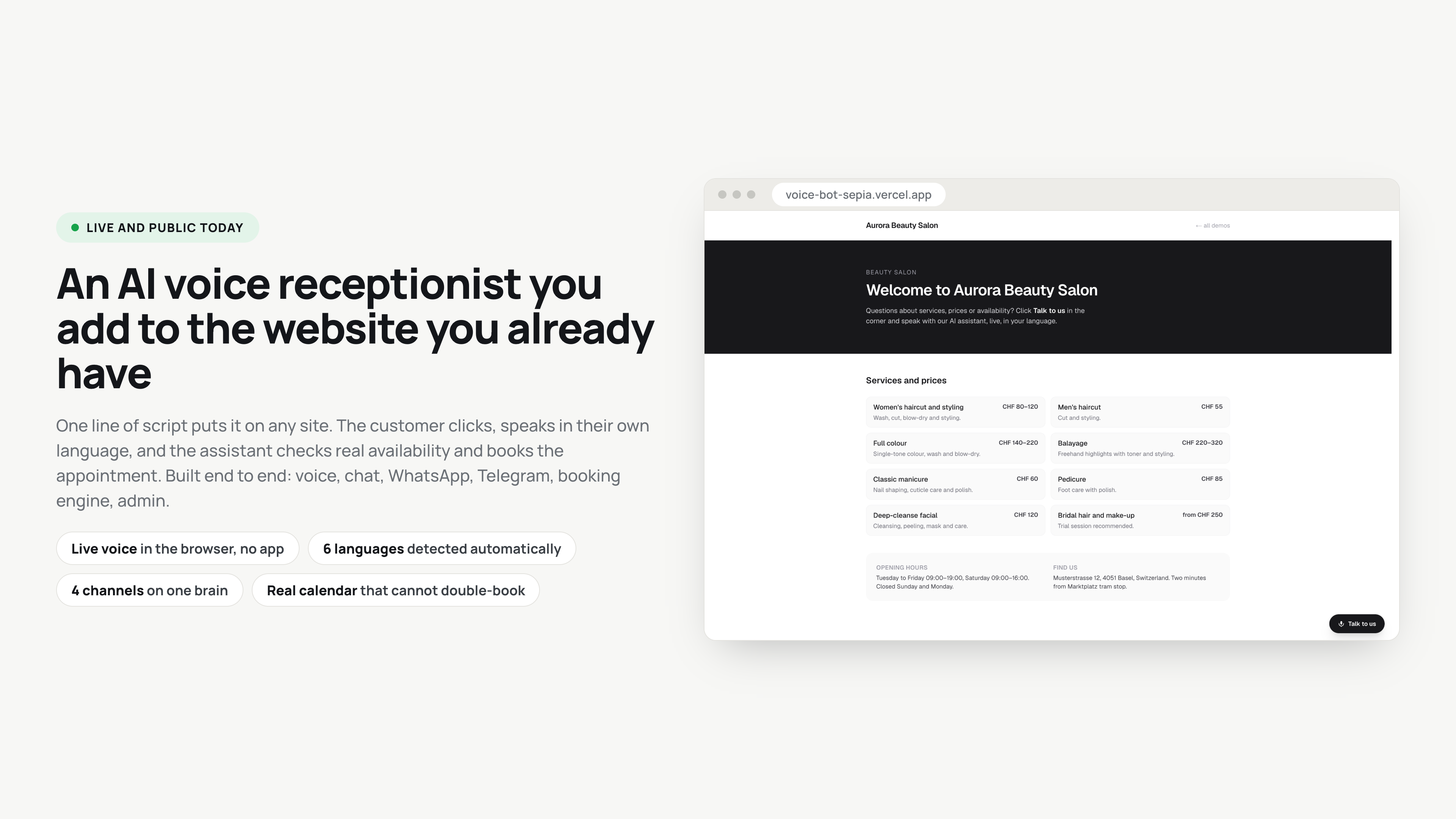
The same prospect can start a voice conversation immediately.
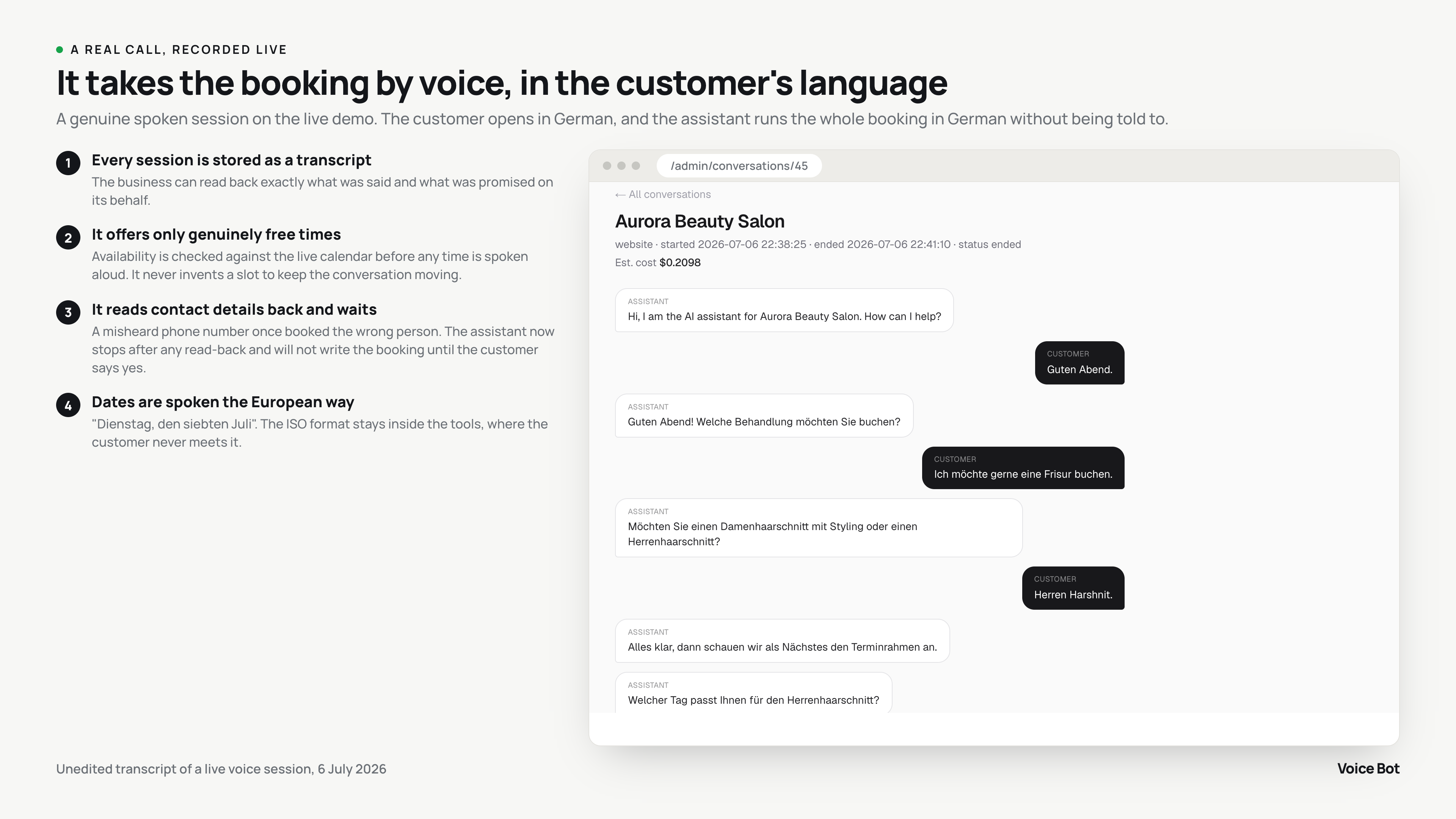
The assistant answers from the business information it has been given: services, opening hours, terms, specifications and cancellation rules. It detects and replies in 6 supported languages: English, German, French, Portuguese, Spanish and Russian. It can also switch languages during the conversation.
It speaks in the manner of a calm and pleasant customer support agent, while introducing itself clearly as an AI assistant so that the prospect is never misled about who or what they are speaking to.
During the conversation, it collects the prospect’s contact details and request. If the prospect is ready to proceed, it can book directly into the calendar while the conversation is still happening. The calendar prevents 2 people from taking the same slot.
The enquiry moves through one connected process: first response, information exchange, booking and a record of what happened.
See the full system working
The video below is a narrated walkthrough of the live product. It shows how the assistant is added to an existing website, identifies itself clearly as AI, answers by voice, follows the customer’s language, checks real availability and completes a booking without creating a double booking.
It also shows what sits behind the conversation: one assistant working across the website, WhatsApp, Telegram and the embedded widget; full transcripts; the recorded cost of each interaction; a lead record for every enquiry; booking and decline statuses; and the reason when an enquiry does not proceed.
The website is the visible front door. The complete system records the enquiry, organises the next action and gives the business a clearer view of what happened.
What lands in the business
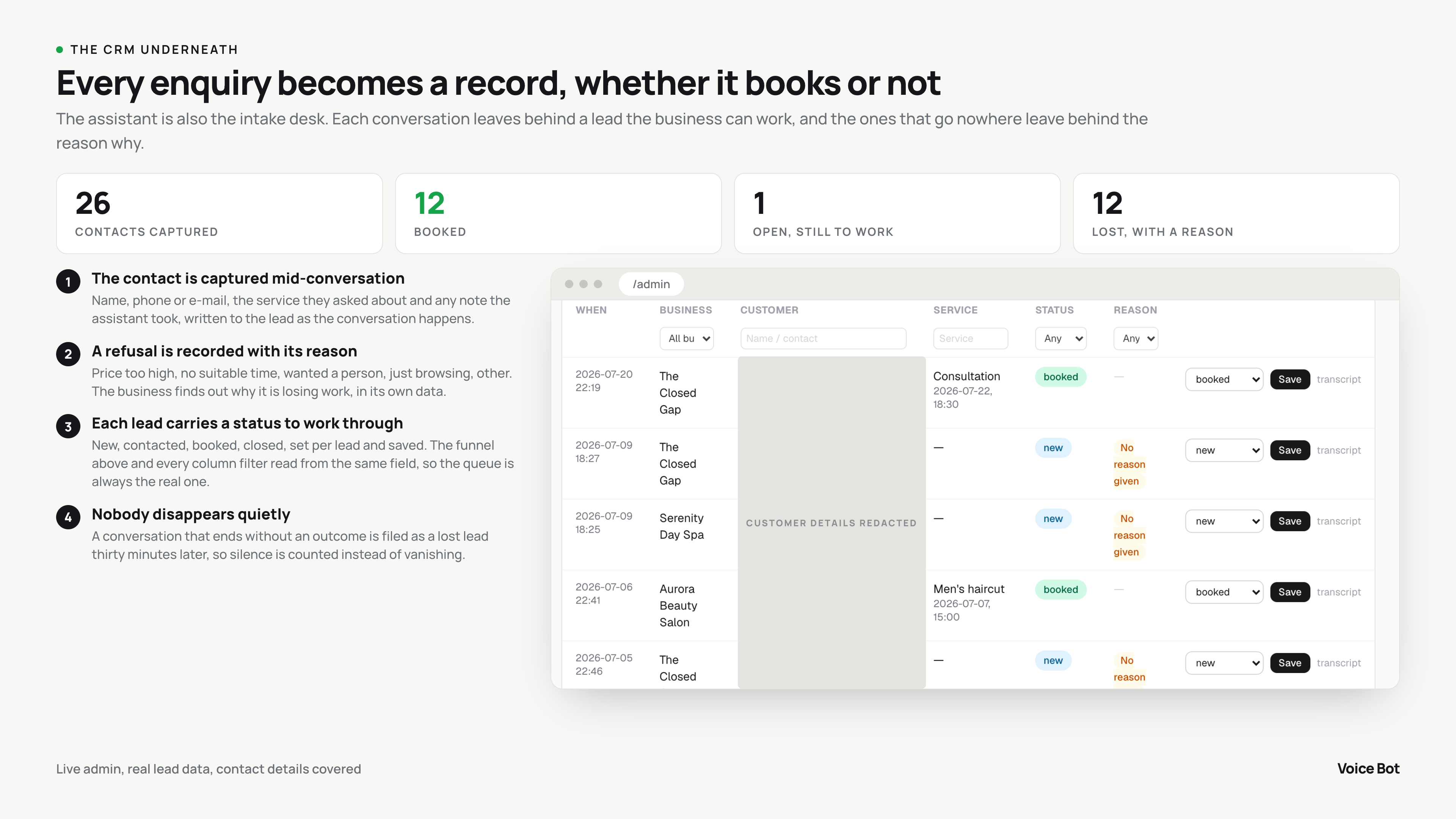
Every conversation becomes a record, whether it ends in a booking or not.
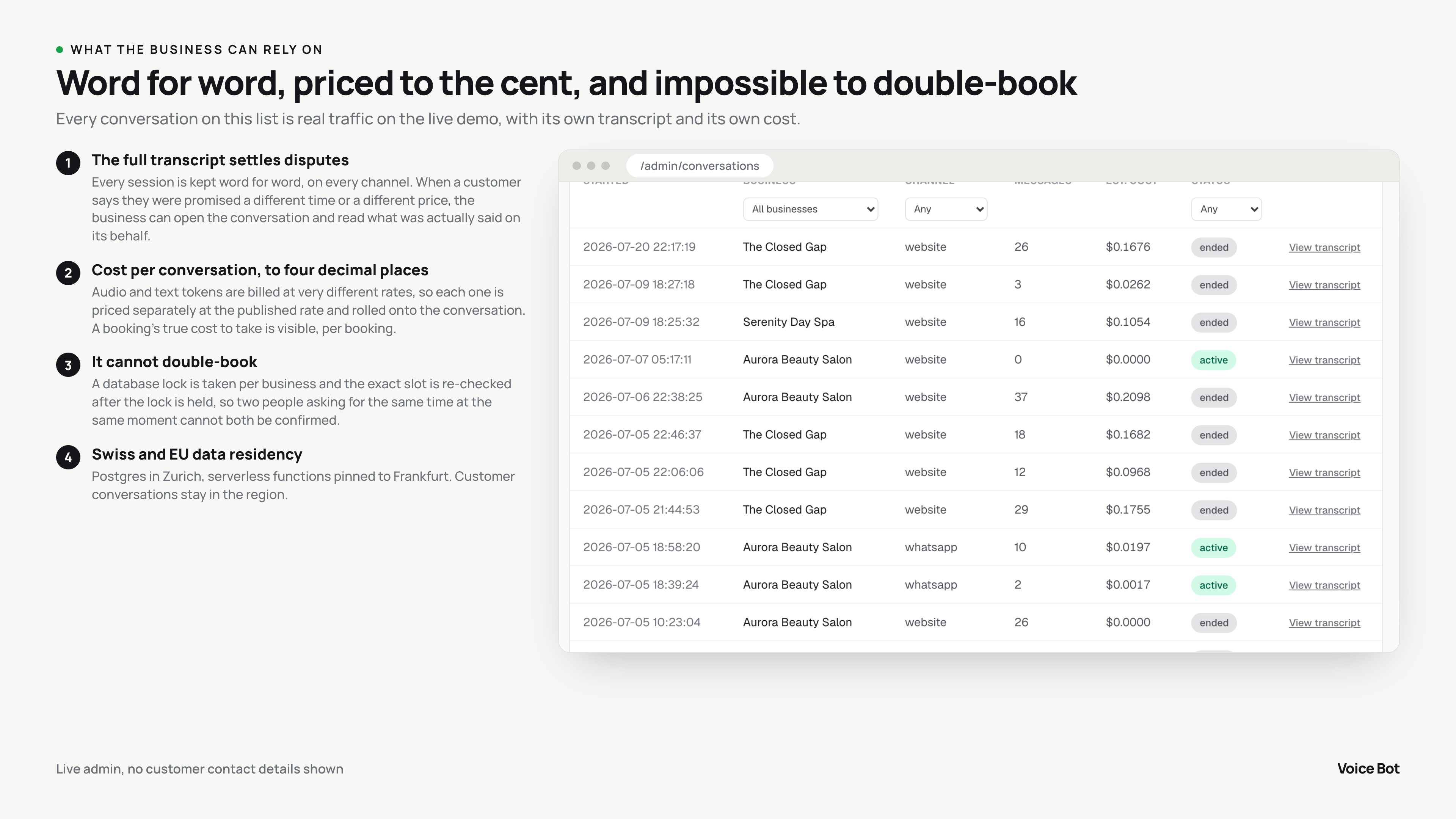
The business can see when the conversation happened, which channel the prospect used, how many messages were exchanged, what the interaction cost and the full transcript of what was said. If the prospect provided their details, the system stores their name, contact information, request and any notes collected during the conversation.
Each enquiry also receives a status. It may be new, contacted, booked, closed or lost. When the prospect decides not to continue, the system can record the reason they gave, such as price, lack of a suitable time, a preference for speaking to a person or simply browsing.
A stated reason is evidence rather than a complete diagnosis. It gives the owner something concrete to investigate instead of relying on impressions.
The team can then see which enquiries still need action, which have already booked and which should no longer consume time. A person remains responsible for the follow-up, the commercial judgement and any situation the assistant cannot or should not resolve.
The screenshots show live demo and test traffic. Customer contact details are covered.
What one conversation costs
The system records the usage cost of every interaction separately. In my sample tests, a website voice conversation cost about $0.21, while a 3-language WhatsApp conversation cost about $0.02.
Those figures show the marginal AI cost of handling one enquiry. The complete system has a wider cost base.
Somebody has already built and configured the system, connected the booking logic and communication channels, and paid for the infrastructure behind it. That may include AI API usage, hosting, database and storage, transactional messages, monitoring and the tools needed to keep the service available.
For most SME owners, the practical model is a managed monthly service that covers the infrastructure, maintenance, updates and technical support, with an agreed level of usage included.
The cost per interaction still matters because it shows that each additional conversation is not prohibitively expensive. The commercial decision should be based on the complete monthly cost compared with the value of faster response, less administrative work and better visibility into what happens to each enquiry.
Run these 4 counts before investing
Start with 4 numbers from your own business:
- How many enquiries reached you outside working hours last month, across phone, email, contact forms and messaging channels?
- How long did those enquiries wait, on average, for the first response?
- How many of the prospects your team followed up with eventually bought?
- Why did the others decide not to proceed?
The fourth question is often the most revealing. If the business cannot answer it, prospects are disappearing without leaving information that management can use.
These numbers show whether there is a meaningful gap in response time, qualification, follow-up or management visibility.
You can then compare the complete monthly cost of improving the process with the value of the enquiries being lost and the employee time currently spent pursuing unsuitable ones. If the numbers show that the gap is small, you may not need to change anything. That is also a useful result.
Test the enquiry flow yourself
The live assistant lets you experience the process from the prospect’s side. Ask a question, change languages during the conversation and try to complete a booking.
I build Commercial Operating Systems around the points where demand, follow-up and ownership break down. This system is one working example of how that operating flow can be redesigned.