The first week of a strategy engagement, in a few minutes.
Early in a strategy engagement, a team spends the first week building scaffolding: framing the problem, sizing the market, building the first model, running a pre-mortem, then checking whether the logic holds. I rebuilt that first week as an 8-role pod you run yourself, free, inside Claude. It does the scaffolding. The judgment stays with you.
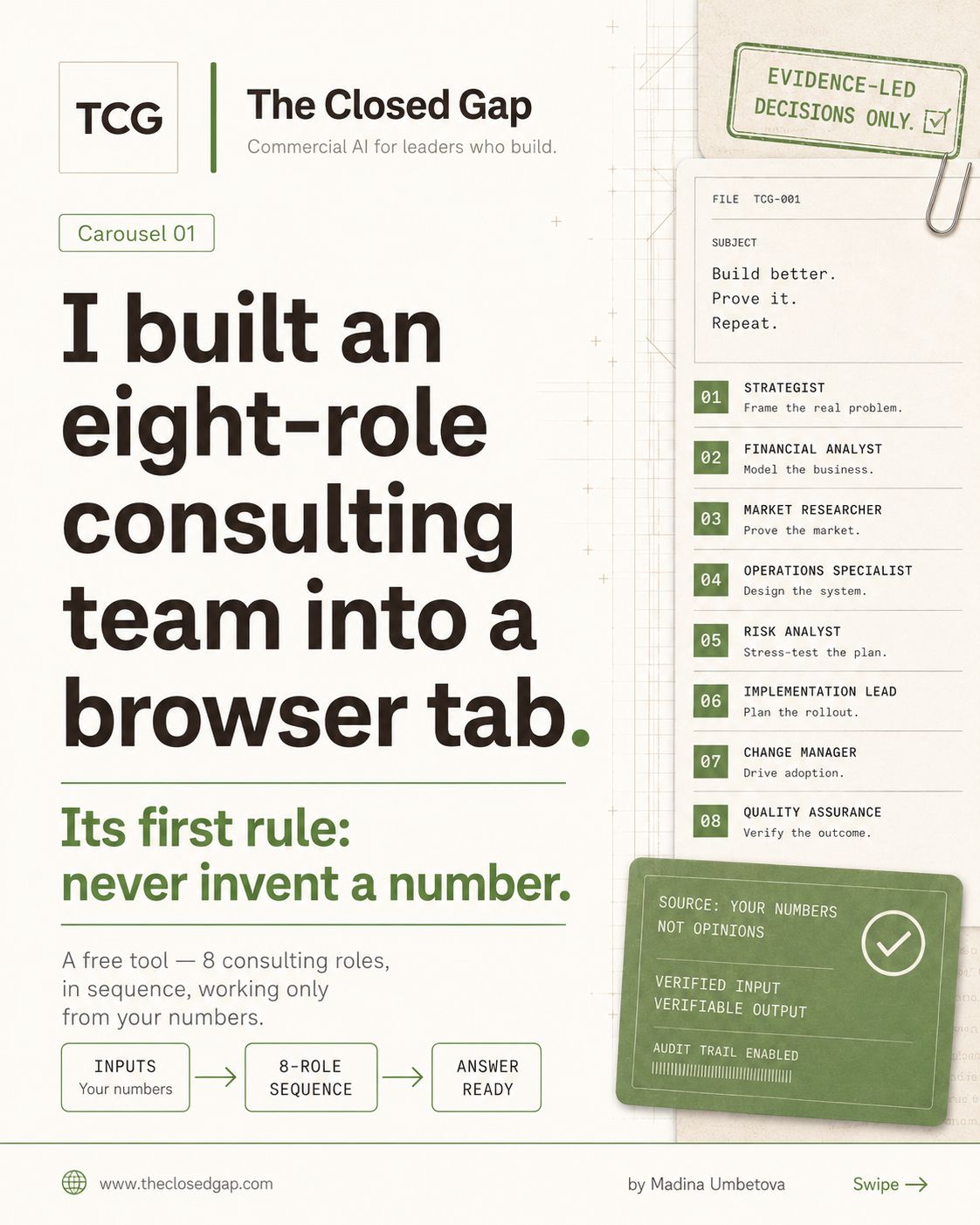
Eight roles, run in sequence.
You give it one business problem. Each role inherits the full thread of everything before it, adds its section, and hands the engagement forward. That accumulation is why the QA reviewer can actually audit the model instead of nodding at it.
Partner
Frames the real problem and commits to a hypothesis you can prove or kill.
Engagement Manager
Turns that into a work plan: streams, milestones, who is needed.
Evidence Framer
Lays out what the answer depends on and flags exactly what to verify. It does not guess, browse, or invent market stats.
Modeler
Builds the business case from your numbers: value at stake, sensitivity, break-even.
Process Analyst
Maps where the workflow leaks time and margin, and designs the fix.
Risk Lead
Runs the pre-mortem: how this fails, the early warnings, the go/no-go lines.
Synthesizer
Writes the one-page answer a CEO could act on: situation, recommendation, why now.
QA Reviewer
Audits the logic and the math, traces every number to its source, and flags anything invented.
It does the process. You do the judgment.
The parts of consulting that were always process are getting cheap. The parts that were always judgment are still yours. The honesty is the whole point: a deck full of confident, invented figures is worse than no deck. This one shows its arithmetic and admits what it does not know.
Good for
Getting from a blank page to a structured first draft in minutes: a frame, a work plan, a rough model, a risk view, and a one-page answer you can react to and sharpen.
Capped by your brief
The output is only as sharp as the problem you write into it. A vague brief gives you confident filler. Context, symptoms, constraints, and what you have already tried give you something worth reading.
Replace the numbers
The roles that touch data will hand you estimates and placeholders. They are flagged. Swap in your real figures before any of it informs a decision.
Five steps, start to finish.
It runs inside Claude, so you sign in with your own Claude account and each run counts against your own usage, not mine.
- Open the pod and sign in with your Claude account.
- Set it to Live. The top switch has two settings. Live runs your real problem. Demo just replays a sample so you can see the shape first. Flip it to Live when you want your own answer.
- Write a specific problem. Context, symptoms, constraints, and what you have already tried. The sharper the brief, the sharper the analysis.
- Run it, and read each role as it completes. The core four (Partner, Evidence Framer, Modeler, Synthesizer) run on a free Claude account; the full 8-role board needs a Pro subscription to run in one pass. Switch roles on or off in the left rail.
- Get your results. When the run finishes, use Download at the top right to save the full analysis as a file, or Copy all to paste it straight into a doc or email. Each section also has its own copy button.
I build one of these in public every few weeks.
Subscribe once and you get one method every week on building commercial AI tools as an operator, plus every new free resource as it lands in the library.