I opened an enquiry for insect screens and closed it before sending my contact details. I expected an on-site visit before I knew whether the price was within reach. The supplier never saw that decision.
One abandoned form identifies a customer moment. It does not establish market frequency or business cost. It gave the design a precise place to start: the customer needs enough price context to decide whether continuing is worthwhile, while the owner needs a complete record and a clear order of attention.
Sofortli is a working demonstration built with sample data. It shows a possible workflow for those two views. The commercial question belongs to a real implementation: can the available team create more useful output from the time, appointments and attention it already has?
Working demonstration. Sample data. Business outcomes require live evidence.
Design the two decisions first
The customer and the owner are making different decisions. The customer needs confidence to continue. The owner needs a reliable next action, a view of limited capacity and a way to see where the process loses momentum.
| Decision to design | Demonstrated system output | Evidence a real implementation would collect |
|---|---|---|
| Does the customer continue? | A sample guide range appears before contact details, with the selected next step recorded. | Journey completion, visits that produce quotes, signed quotes and travel per signed order. |
| Where does the owner focus today? | One sample CRM record holds stage, estimated value, next action and an explainable readiness index. | Response time for high-readiness enquiries, overdue actions and signed value per available owner hour. |
| Which visits fit the working day? | Route-aware appointment choices and a sample proposed sequence. | Travel time, fuel use, productive visits per day and travel per completed job. |
| Where is value being lost? | A lead-to-sale waterfall shows sample stage counts and the largest stage loss. | Stage conversion, stalled pipeline value and the result of each weekly intervention. |
Evidence view: price before commitment
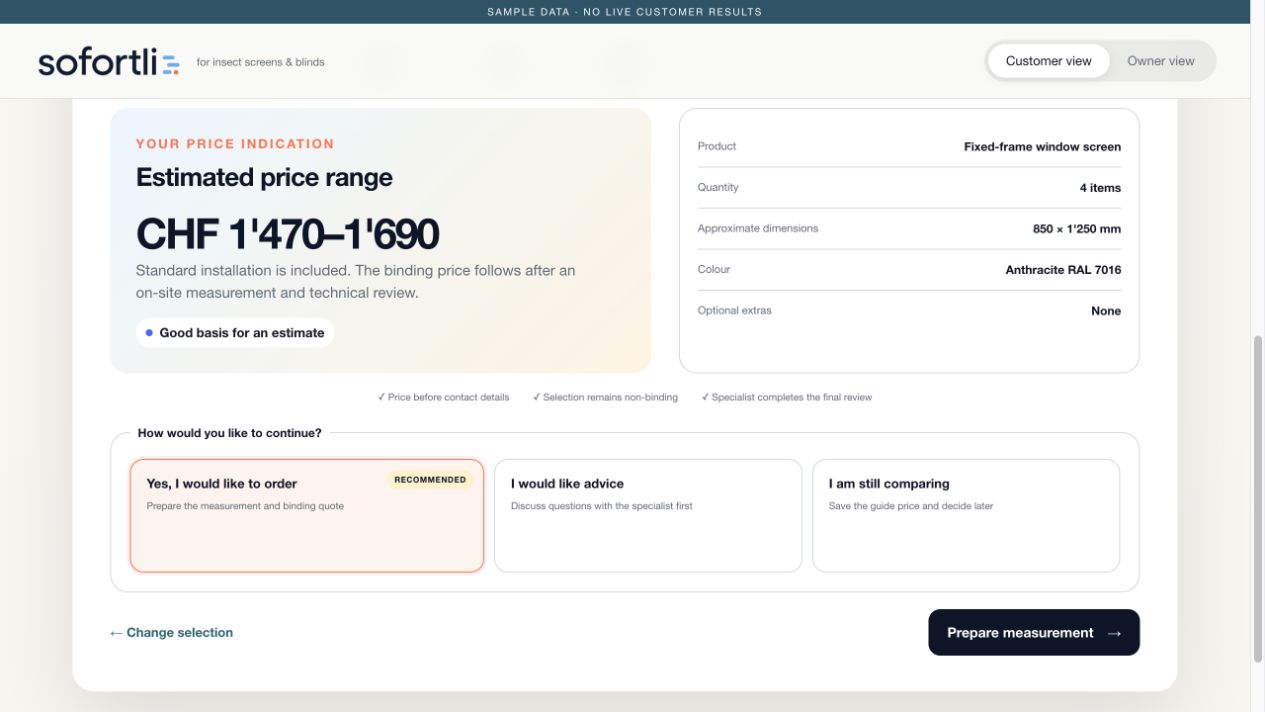
The customer view asks for the product route, approximate dimensions, colour and options. It then returns a sample guide range before contact details. The final price remains with the qualified person after measurement and technical review.
Evidence view: a visible order of attention
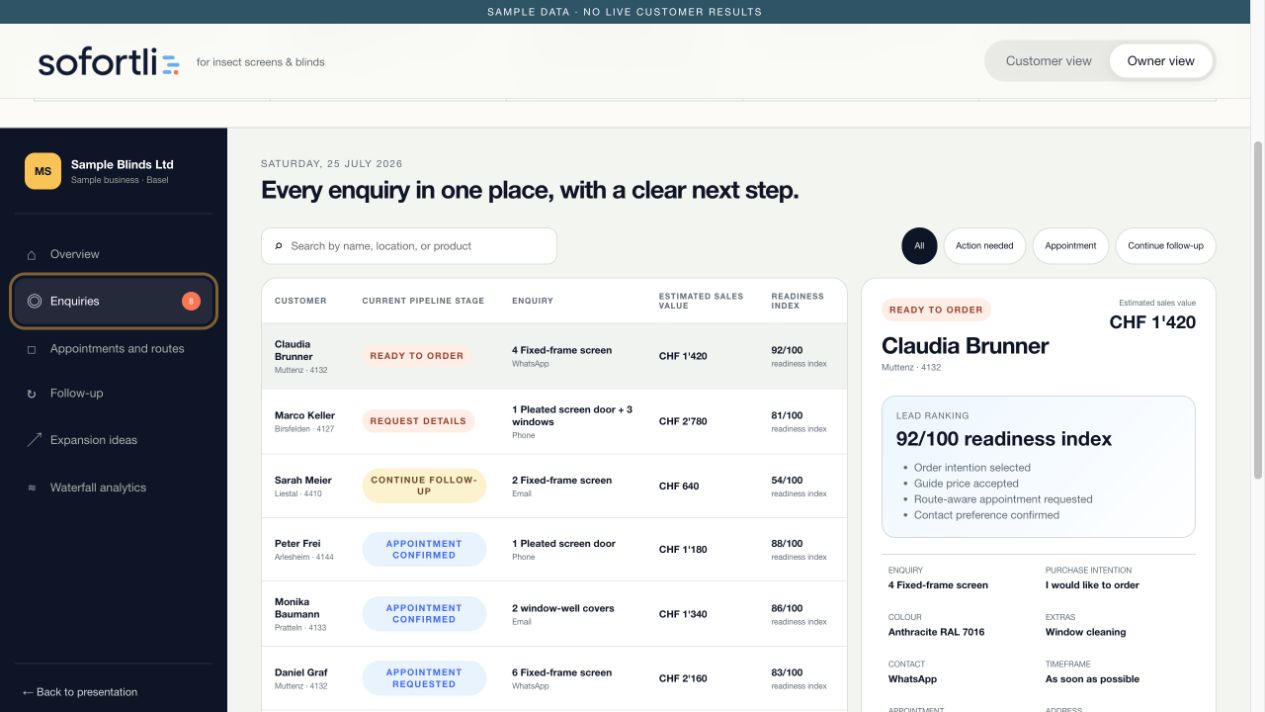
The owner view places the product, approximate measurements, guide range, stated intention, estimated sales value, stage and next action in one sample record. The interface currently labels the transparent score a readiness index. Its visible inputs support an action queue; they do not establish a calibrated conversion probability.
Map all 12 jobs to the right mechanism
A workflow can contain AI while most of its useful work belongs to information design, structured data, rules, automation, optimisation, analytics or qualified judgment. Sofortli keeps all 12 jobs visible so the business can test and govern each one.
| Workflow job | Correct mechanism | Demonstrated or intended output |
|---|---|---|
| Explain the need and collect known choices | Information design | A guided customer journey and structured selections. |
| Store the enquiry, value, stage and next action | CRM data model | One current sample enquiry record. |
| Calculate a guide range and check normal conditions | Approved business rules | A consistent sample range and visible exceptions. |
| Create the record, confirm the enquiry and run scheduled follow-up | Automation | An in-browser sample record, confirmation and follow-up history. |
| Rank early enquiries from visible signals | Transparent business rules | An explainable readiness index and ordered queue. |
| Group requested visits against addresses, time windows and capacity | Scheduling or optimisation engine | A sample route and appointment sequence. |
| Count movement through the commercial stages | Analytics | A sample lead-to-sale waterfall and loss point. |
| Interpret free text, voice, language variation or photographs | AI with confirmation | A proposed structured summary in a real implementation. |
| Identify missing decision-critical information | AI with confirmation | A proposed clarification linked to the missing requirement. |
| Prepare the customer response from controlled inputs | AI with confirmation | A draft response using approved prices, terms and appointment choices. |
| Prepare the owner's decision briefing | AI with confirmation | A concise draft briefing with the supporting source signals. |
| Confirm suitability, measurements, exceptions and a binding quote | Qualified person | An accountable final recommendation and price. |
AI has four intended jobs inside that boundary: interpret the enquiry, identify missing decision-critical information, prepare a customer response and prepare an owner briefing. Each output requires confirmation and should be measured through acceptance, correction and rejection patterns. AI interpretation and recommendation remain design intent for a real implementation; the current public demonstration labels those outputs accordingly.
Evidence view: capacity is a planning problem
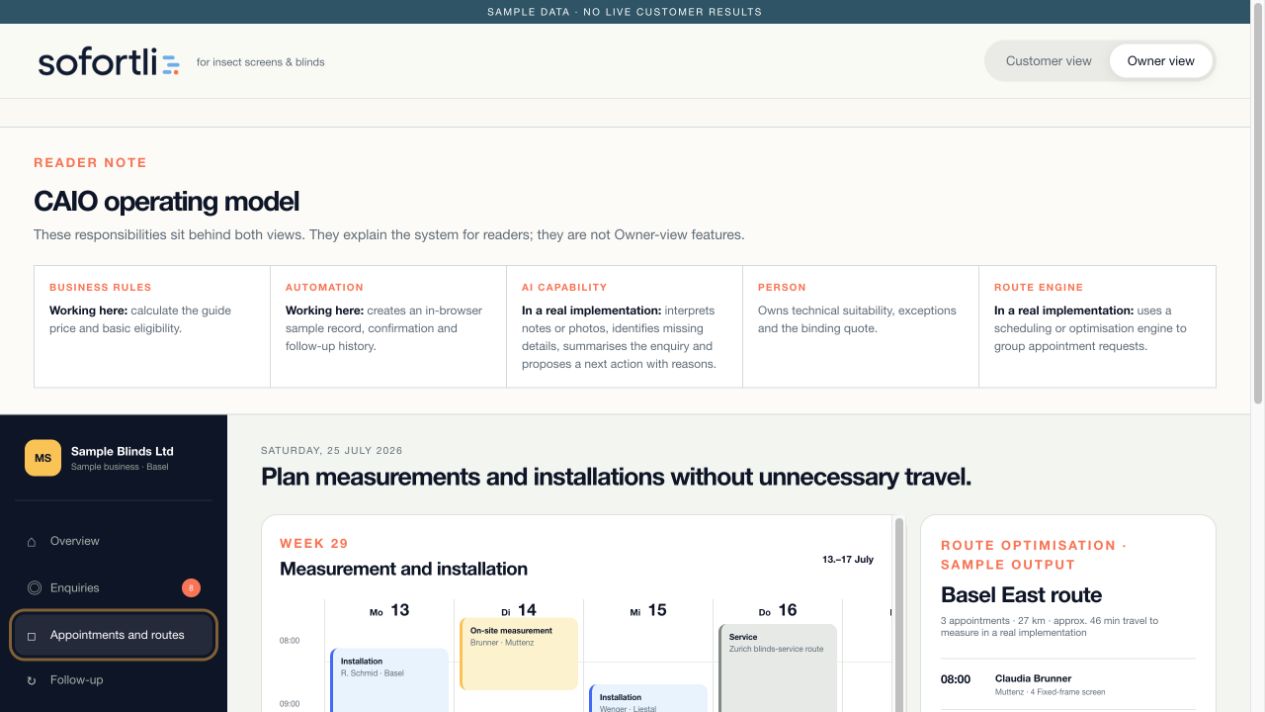
An attractive booking journey still needs to produce a workable operating day. The demonstrated route groups three sample appointments across 27 kilometres and approximately 46 minutes of travel. Any travel, fuel or capacity benefit requires comparison with a live baseline.
Evidence view: activity needs a loss point
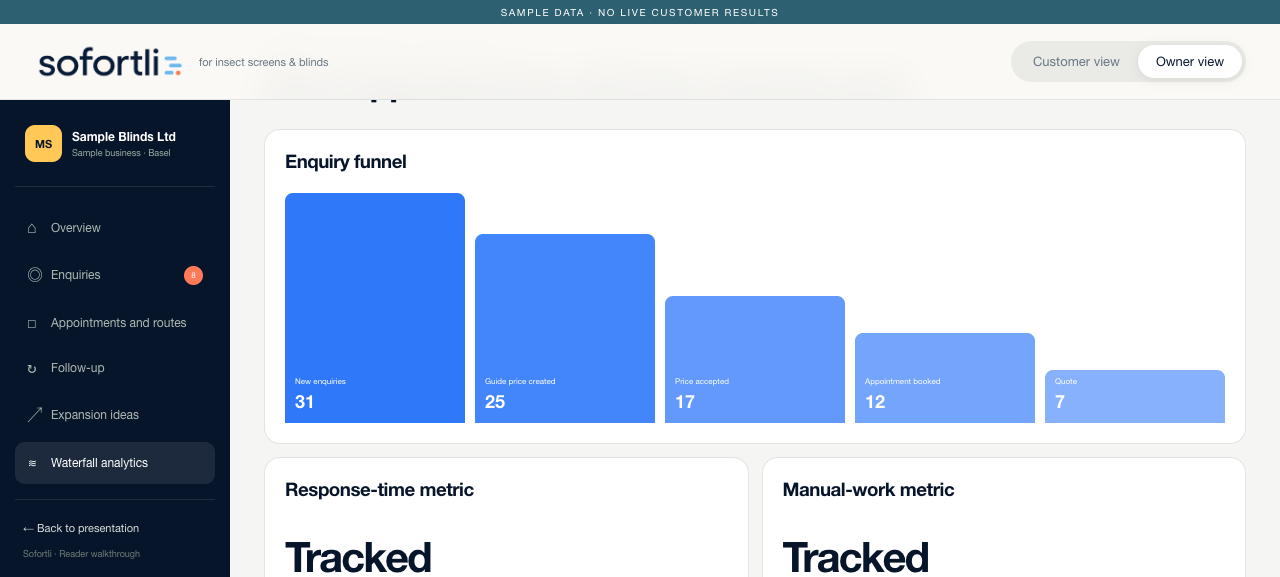
Individual records explain the next action. A waterfall shows the point where the process is thinning out. In the current sample funnel, 31 new enquiries become 25 guide prices, 17 acceptances, 12 appointments and 7 quotes. The largest single-stage sample loss is 8 between guide-price creation and acceptance. A live business would test the reason for that loss before changing the journey.
The evidence loop
The case study is useful when the workflow can be judged as a complete loop. The owner can keep, change or remove a capability when the problem, system output, decision owner and evidence are explicit.
| Question | Required answer before keeping the capability |
|---|---|
| What problem is being addressed? | Mark it as observed, reported or inferred. |
| What does the system produce? | Name the visible output without turning it into an outcome claim. |
| Who owns the decision? | Name the mechanism and the person who remains accountable. |
| What would count as improvement? | Set a baseline and attach an operational or commercial measure. |
| What would change the design? | Review acceptance, correction, stage-loss and outcome evidence after live use. |
The evidence views come from the Sofortli working demonstration. Every person, value, route, score and funnel value shown there is sample data.